Greetings. I’m Dave, an amateur astronomer, just enjoying the beautiful and rare dark skies of a rural community. Pictures and musings about astrophotography are on the Blog pages, so head right over there unless this is your first visit.
Still here? Check this out: My Adirondack Story. It’s a 5 minute audio file. After you listen, do head over to the My Adirondack Story website to check out other great stories of life in the Adirondacks!
And check out this article concerning light pollution in Adirondack Life Magazine!
Reimagine: stargazing in Petersham
Petersham, MA., that is.
I started stargazing in the Adirondacks and If you’ve seen this blog, you know that – so enticing is the dark Adirondack night sky, that this former dweller of Boston suburbs was drawn to learning astrophotography after moving there. Soon, I started sharing views through an 8” SCT telescope. It was a transformation of sorts from an armchair astronomer into the “Neophyte Astronomer”. It also was the beginning of “Impromptu Stargazing”.
And, perhaps not so much a neophyte after ten years of practice. Maybe this lover of astronomy can now be simply known as an “amateur astronomer”. For the term “amateur” (nor neophyte) is not necessarily a disparaging word. The term “amateur” is derived from the Latin amator or ‘lover’. In my case, a lover of the night sky.
I’ve enjoyed meeting folks up at Norton Cemetery in Keene, NY. during my time there (see below). More so than even the stargazing itself. I’ve met so many interesting people and made tons of new friends while sharing my telescope and the night sky. Through occasional cold, humidity, fog and dew, we’ve seen eclipses, planets, nebulae, galaxies, meteors, comets and asteroids together. And the moon as well. Time spent serenaded by the barred owls and coyotes under moonlight was an eerie extra bonus!
But things change and after 25 years in the Adirondacks, it’s time to move on. Or should I say back – back to Massachusetts. But not back to the suburban hustle that is the RT-128 corridor. Rather, to the quiet north-central town of Petersham.
Petersham is closer to stuff – closer to family, yet still rural enough to enjoy stargazing. Indeed, relatively low light pollution was a prime factor in picking a new home in Massachusetts. And I can still see the Milky Way!
But sky glow in Petersham is definitely more pronounced than in the Adirondacks. Oh well, you can’t have everything. For a Massachusetts town, sky glow from artificial lighting isn’t horrible here and astrophotography should still be a viable activity. Not much to be done about Elon Musk and his growing constellation of light polluting satellites, but that’s another story.
Light pollution will never be an easy problem to solve and it continues to get worse. It’s a problem that creeps up on you. As well-meaning people and municipalities add inexpensive LED lighting with little concern for the quality of that lighting – it just creeps up. And there are other’s to whom light pollution just never crosses the mind.
I hope that sharing views of the night sky raises awareness of how streetlights, commercial lighting, and homeowners exterior lighting affects the night sky as well as the other natural inhabitants of this world. Note I say “this” and not “our” world. For we and the plants and animals all live here together, and light pollution affects migration patterns, insects, and all of our biologies.
In any case, I plan to continue “Impromptu Stargazing” as time and conditions permit. I’m searching for a suitable location here in town, but starting with the field adjacent to the Petersham library for now. I’m hoping to meet more night-sky loving people here weather permits. If you find yourself in the north-central Massachusetts area, check out my contacts page to sign up to be notified of “Impromptu Stargazing”. Stargazing with less than a day notice depending on the weather and my mood and schedule. Stop by and join other lovers of the night. We’ll be glad to meet you!
Stargazing in the Adirondacks
I got into stargazing in the first place after moving from the Boston suburbs to the heart of the Adirondack High Peaks about 25 years ago. I was struck by the beauty of the night sky and discovered the Milky Way for the first time – not visible from the city.
I was always interested in astronomy – ever since abandoning hope of becoming an astronaut at age 9. But my pent-up excitement – quashed by time spent in an urban area – was unleashed after discovering the Adirondack night sky. And when my wife and I happened across a 4 1/2″ Newtonian reflector in a toy store window – we jumped at the chance to begin sharing the views with our son – also about 9 at the time. He’s now a real-life astrophysicist!
But city dwellers can only dream of beholding such celestial beauties as the Milky Way and Andromeda galaxies. These are naked-eye objects in the Adirondack park where the sky glitters with jewel-like objects!

I started this blog to chronicle my adventures, share some photos, and perhaps even offer a few viewing and equipment tips as I fumble my way through this hobby of amateur astronomy. And so enticed was I upon gleaning the Great Ring Nebula (M57) – my first “deep sky object”, that I set aside our 4 1/2″ Newtonian in favor of a new 8″ Schmidt-Cassegrain telescope – a Celestron CPC-800 XLT.
Dwelling on a wooded lot as I do precludes the use of a permanent pier or observatory. Therefore, I do my observing at a local cemetery. This location boasts easy access and a 360° view down to about 12° of elevation, hindered only by the mountainous terrain and mercurial weather. There’s even a well-located picnic table. I use the space respectfully and never leave anything behind.
But I became lonely in the cemetery, surrounded only by the lost souls and eerie echos of coyote song.
I thought – I’m in a public place that’s easily accessible, what an opportunity to share astronomy with my neighbors! So now I look forward to inviting neighbors as I setup my telescope, and have discovered that astronomy outreach is a reward in itself!
I love sharing the views. I’ve met lots of people and I delight in their reactions to first seeing the rings of Saturn or some deep sky object. So if you’re ever in the Lake Placid, NY. area – contact me! I’ll add you to my email list and we’ll go star-gazing!

My CPC-800 XLT telescope is portable enough to be running in about 10-15 minutes. I initially decided to stick with the stock altazimuth mount. This is fine for visual observations but I eventually longed to try my hand at taking a few pictures.
Those first crude attempts at astrophotography using nothing but the stock CPC-800 and a Canon DSLR were enticing, but also frustrating. An altazimuth mount is not suitable for taking more than the shortest exposures due to a phenomenon know as field rotation. No matter how well the telescope tracks motion of the stars, they will appear to rotate around the center of the field. This ruins any exposures longer than about 30 seconds.
I knew what I needed – a wedge. A wedge is nothing more than a heavy chunk of metal that mounts the telescope at an adjustable angle – set to match the latitude of the observing site. This sets one axis of the telescope pointing to the north celestial pole so the telescope rotates about only this one axis while tracking.
I wanted to learn how to perform polar alignments before spending money on a big, mindless chunk of metal. And so, I made my own wooden wedge before taking that path.
I realized that adding a wedge would necessarily complicate setup and alignment and cost valuable observing time. But experiments with the wooden wedge were successful, and I eventually did buy the Celestron heavy-duty wedge.
Now I polar-align the telescope nearly every time I go out observing – even if only visually – with the goal of getting good enough to perform this procedure in a hurry. I can be set up and polar aligned in about 30 minutes on a good night. Speed is important since I have to set things up every time I observe.
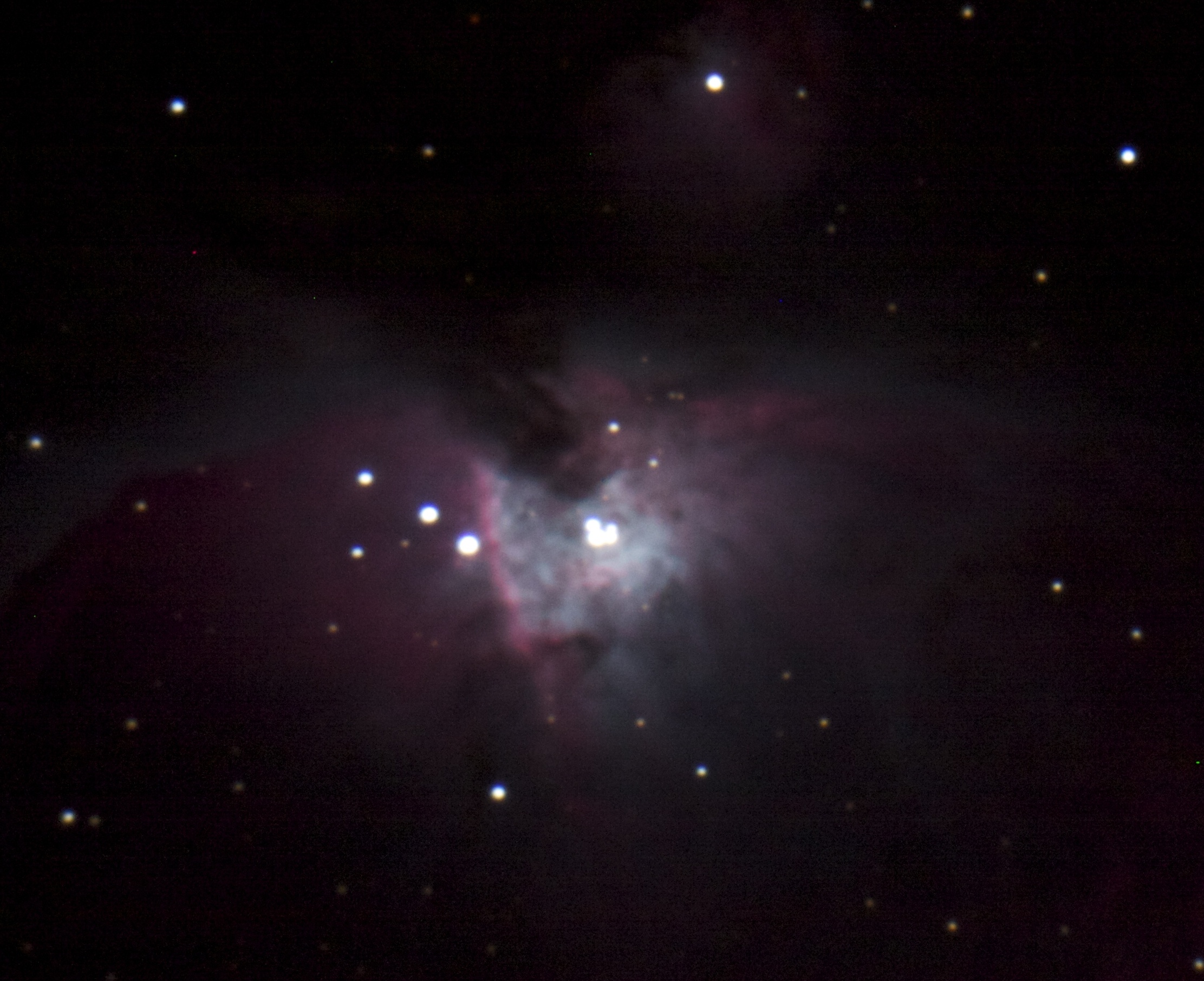
Without the wedge, the altazimuth mount of the CPC-800 curtailed my ability to do astrophotography. But not enough to keep me from trying at first! Even my first crude photographs of the Orion Nebula were enticing and revealed colors that were barely visible through the eyepiece.
I continue to experiment and improve my astrophotography skills, and I hope that trend begins to emerge in my blog entries.
I’m often joined by my friend Kevin who has similar equipment, and we share views of the heavens through my 8″ and his 9.25″ telescope. We observe when conditions are favorable, when we have time, and when the mood strikes us. So we provide only short notice – sometimes a day, sometimes a couple of hours. Thus was born “impromptu stargazing“!
If you find yourself visiting the Lake Placid region of the Adirondacks then perhaps you’d like to join us too? Contact us to be added to the email list.
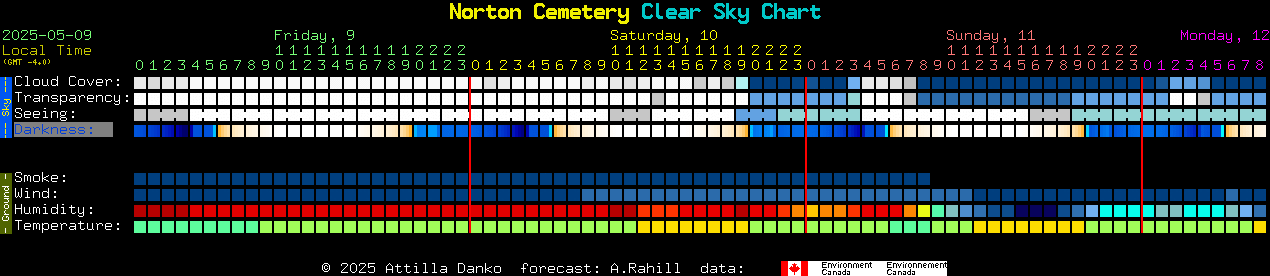
Astronomers are dependent on clear, dark skies. Here’s the astronomers forecast from ClearDarkSky.com for Norton Cemetery. It’s also available from the widget menu of every page.
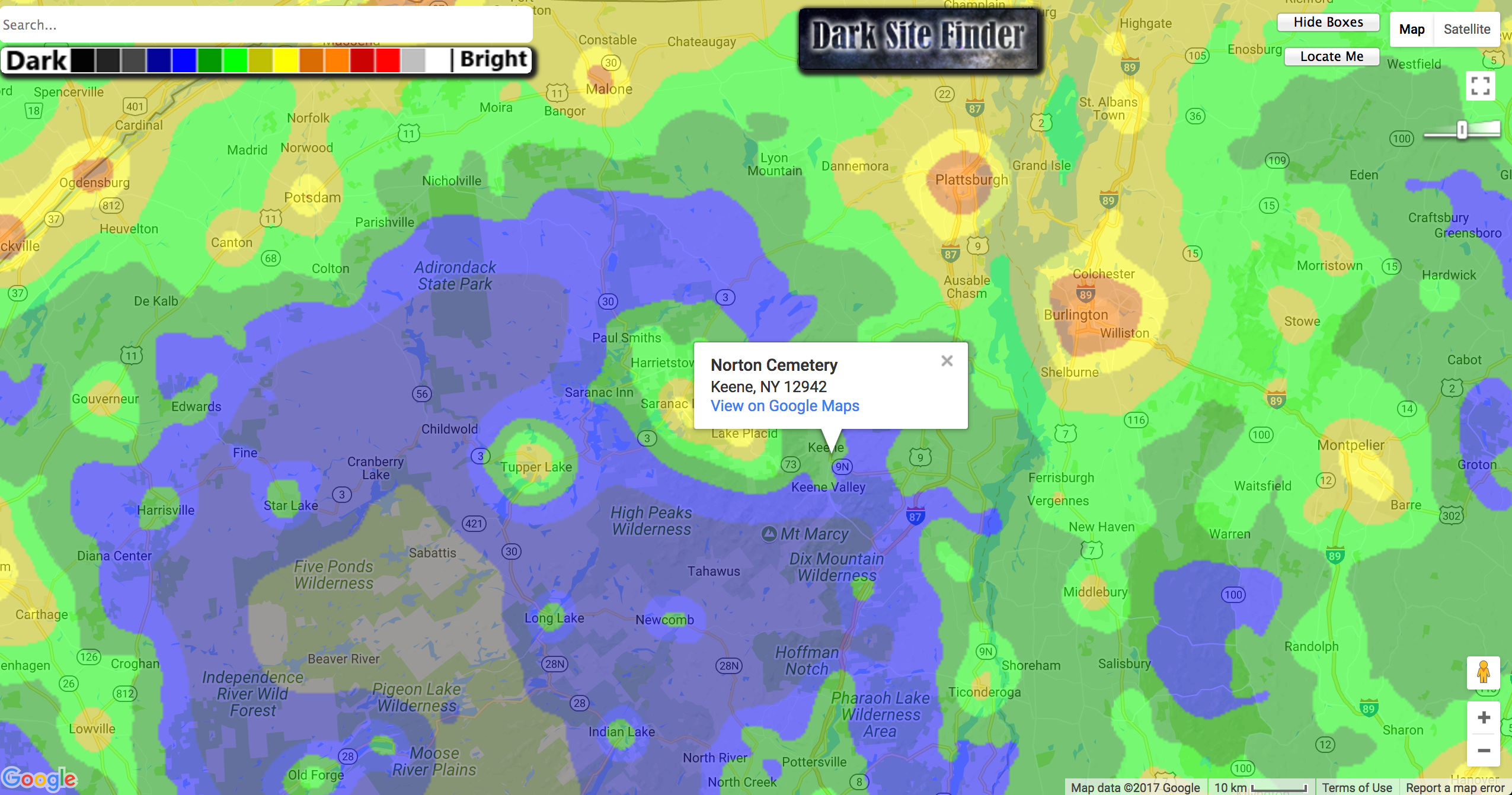
As I alluded to above, dark skies are becoming a rarity. This isn’t foremost in the busy minds of most people, yet “you don’t know what you’ve got ’till it’s gone!” – Joni Mitchell
 The Neophyte Astronomer